Moving Guide
Moving Industry Trends & Statistics

Moving is a constant in American life, but how, why, and where people move is always evolving. Recent data reveals a historically low mobility rate alongside new patterns driven by remote work, economic shifts, and lifestyle preferences. This guide dives into key moving industry statistics, emerging trends, decision factors, regional patterns, economic and demographic impacts, technology’s role, and how the storage sector ties into these moving trends. Whether you're planning a local or long-distance move, this information can help you understand the current moving landscape.
Key Moving Statistics at A Glance
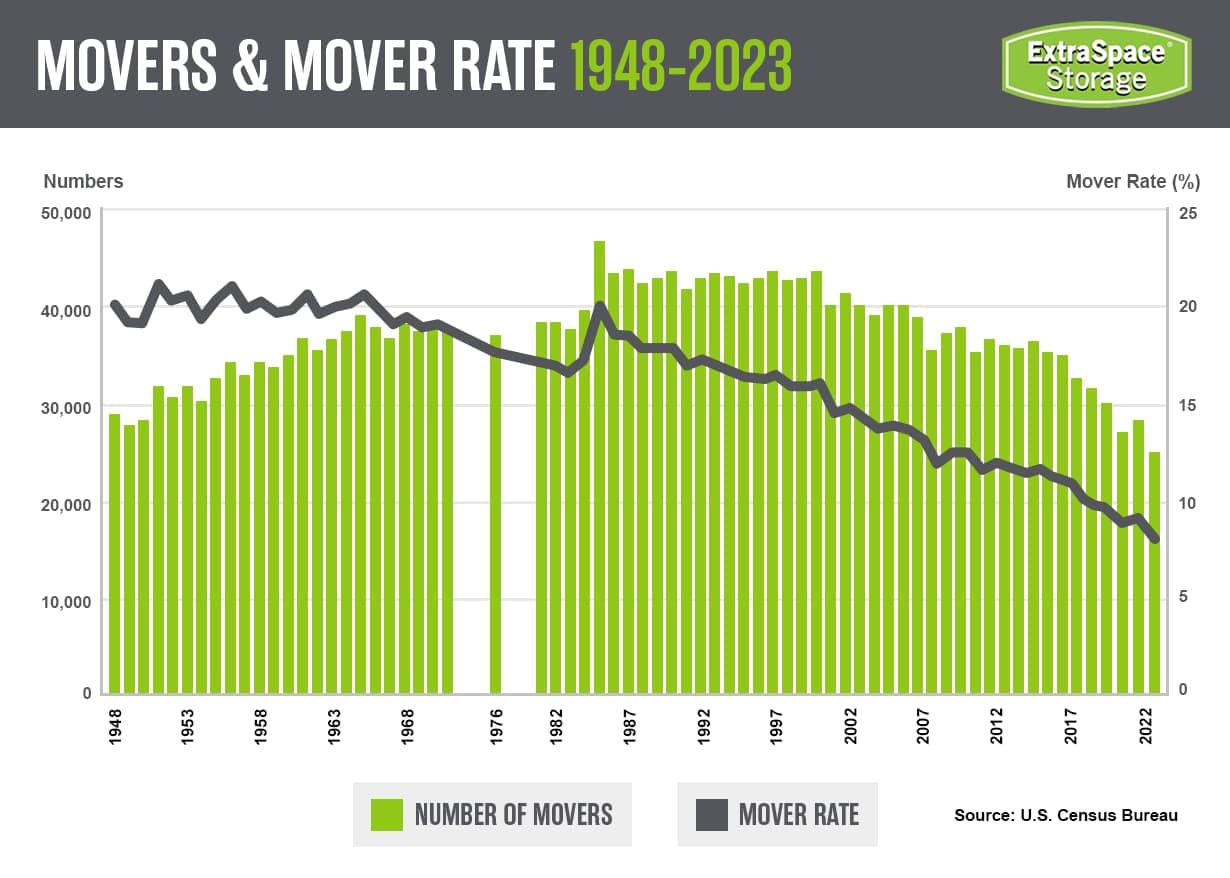
The national mobility rate hit its lowest point on record in 2024, with just 11.8% of Americans changing residences that year, according to Census Bureau data analyzed by Harvard's Joint Center for Housing Studies.
The average American moves about 11 times in their life.
Approximately 48% of movers opt to skip professional services, relying instead on DIY methods and assistance from friends and family.
May through September is the busiest time to move.
Recent industry analyses project the moving industry to be worth $25.7 billion in 2026.
Around 78% of people who move stay in the same state.
Our Methodology
This guide draws on U.S. Census Bureau migration and mobility data, IBISWorld industry market analysis, and moving and self-storage industry research. Because these sources track different populations—government survey data reflects the general population, while industry and consumer surveys often capture specific subsets like recent movers, renters, or storage customers—figures on the same topic won't always align exactly across sources. Data reflected here was last reviewed in August 2026.
Emerging Trends in the Moving Industry
Even as overall mobility slows, new moving trends have emerged in recent years that are reshaping the industry.
Local Vs. Long-Distance Moves
A defining trend over recent years has been the shift toward more long-distance and out-of-state relocations. While local moving volume dipped during the pandemic era, long-distance moves gained steady momentum that continues. Fueled by the lasting normalization of remote and hybrid work, more movers are prioritizing intentional, long-term lifestyle upgrades—with factors like lower housing costs, lower taxes, and more space—over reactive relocations for specific jobs.
Affordability & Quality of Life
Recent data shows that 61% of movers cite affordability and quality of life as primary factors for moving outside urban cores. Whether it's young professionals chasing better work-life balance or parents wanting to relocate to safer, more family-friendly places with larger homes, these changing priorities are driving rapid growth across mid-sized cities, suburbs, and "exurbs" that offer both space and value.
Generational Trends
Demographics are another driving force in moving trends. As the youngest Baby Boomers reach their early 60s and the oldest cross into their 80s, retirement-driven moves are increasing. Downsizing, moving closer to family, and staying in a community remain high priorities for people when considering retirement housing options. Generation X, now in their 40s and 50s, are settling into long-term homeownership while Millennials—currently in their 30s and 40s—are driving suburbanization as first-time homebuyers after historically renting longer than previous generations due to high housing costs, student loan debt, and delayed family formation. Meanwhile, Gen Z has become the renter-majority generation due to transitional life changes like moving for college and moving for work while establishing careers. Different generations are also tending to favor different locations:
Baby Boomers: Sunny, retiree-friendly states in the Southeast and Southwest, especially the Carolinas and Arizona.
Gen X & Millennials: Both prefer Florida and Texas most. Gen X otherwise leans toward the Southeast and Mountain West, while Millennials are more likely to seek jobs in California and the Midwest.
Gen Z: Dense, job-rich college hubs, favoring Texas, California, New York, Illinois, and Colorado.
AI & Tech Integrations
Technology is fundamentally changing how people relocate in 2026, making the entire moving process clearer, faster, and more convenient. Moving leaders are integrating AI and digital platforms to streamline operations and remove friction from the customer journey through key innovations:
AI-Powered Pricing: Generates fast, personalized, and accurate estimates upfront.
Augmented Reality Tools & Virtual Home Surveys: AR spatial mapping by helping people conduct digital walk-throughs of homes, plan furniture layouts virtually, optimize truck packing, and book instant, trackable help for
last-minute or smaller moves.
Digital Inventory Management: Apps enable quick cataloging of belongings using photos, videos, or descriptions.
Real-Time GPS Tracking: Offers complete visibility of shipped belongings throughout a move.
Proactive Communication: Minimizes logistical surprises, giving customers greater peace of mind.
Sustainability Considerations
Some relocation trends are increasingly driven by environmental, political, and economic factors. Climate concerns—like wildfires and extreme weather—alongside state policy alignment are actively influencing where people choose to live. Among individual movers, there has also been an increased focus on eco-friendly moving trends like opting for sustainable packing supplies or booking moving companies that offer route optimization and use fuel-efficient vehicles.
Factors Influencing Moving Decisions
Why do Americans move today? Reasons for moving are often tied to major life changes or opportunities—here are some of the most common reasons why people move.
Housing Needs
Housing-related reasons remain a consistent reason for relocating across demographics. When it comes to home size, people generally want a medium-sized house averaging around 2,200 square feet. Staying within budget is a major goal—28% care more about affordability than location, about a third are open to buying a fixer-upper to save money—especially when buying their first home—and half are considering using a home warranty to protect against unexpected repair costs.
Familial Changes
According to census data, 26.5% of movers in recent years cite family factors—like marriage or moving in with a partner, divorce, having children, or wanting to live closer to aging relatives—as reasons for moving. Finding a home that can accommodate multigenerational living with in-law suites or ADUs has also become important to some seeking to combat elevated housing and childcare expenses.
Career Shifts
Career and life-stage changes remain powerful engines for relocation, though the motivations behind them evolve as people move through the workforce. During peak working years, employment continues to drive long-distance moves—even as widespread remote work enables many professionals to change jobs without changing addresses. Current job market challenges are also causing some to stay put to minimize financial risks.
Retirement
As careers wind down, retirees are largely focused on improving quality of life by seeking warmer climates in tax-friendly states. Downsizing from large family homes into low-maintenance, single-story properties or active adult communities is a priority for many. Some retirees also choose to live a snowbird lifestyle, moving to warmer places during the coldest parts of the year.
Lifestyle Preferences
Lifestyle, environment, and personal values are playing an increasingly dominant role in relocation decisions. While specific triggers like better school districts, safety, health needs, walkability, or climate concerns motivate many, moving decisions rarely happen in a vacuum—they typically involve overlapping economic, life-stage, and quality-of-life factors. Crucially, the rise of remote work has shifted this balance, enabling people to prioritize preferred communities and family proximity over physical job locations.
Regional Moving Patterns
Moving trends vary across the country, with clear regional patterns in where people are moving. The American South is emerging as the most popular destination for new residents.
The South (46%): Captures nearly half of all U.S. moves, leading the country in overall inbound migration.
The West (25%): Draws a quarter of all movers, remaining a desirable region.
The Midwest (18%): Sees modest inbound moves as population growth lags behind southern regions.
The Northeast (11%): Experiences the lowest share of inbound relocations.
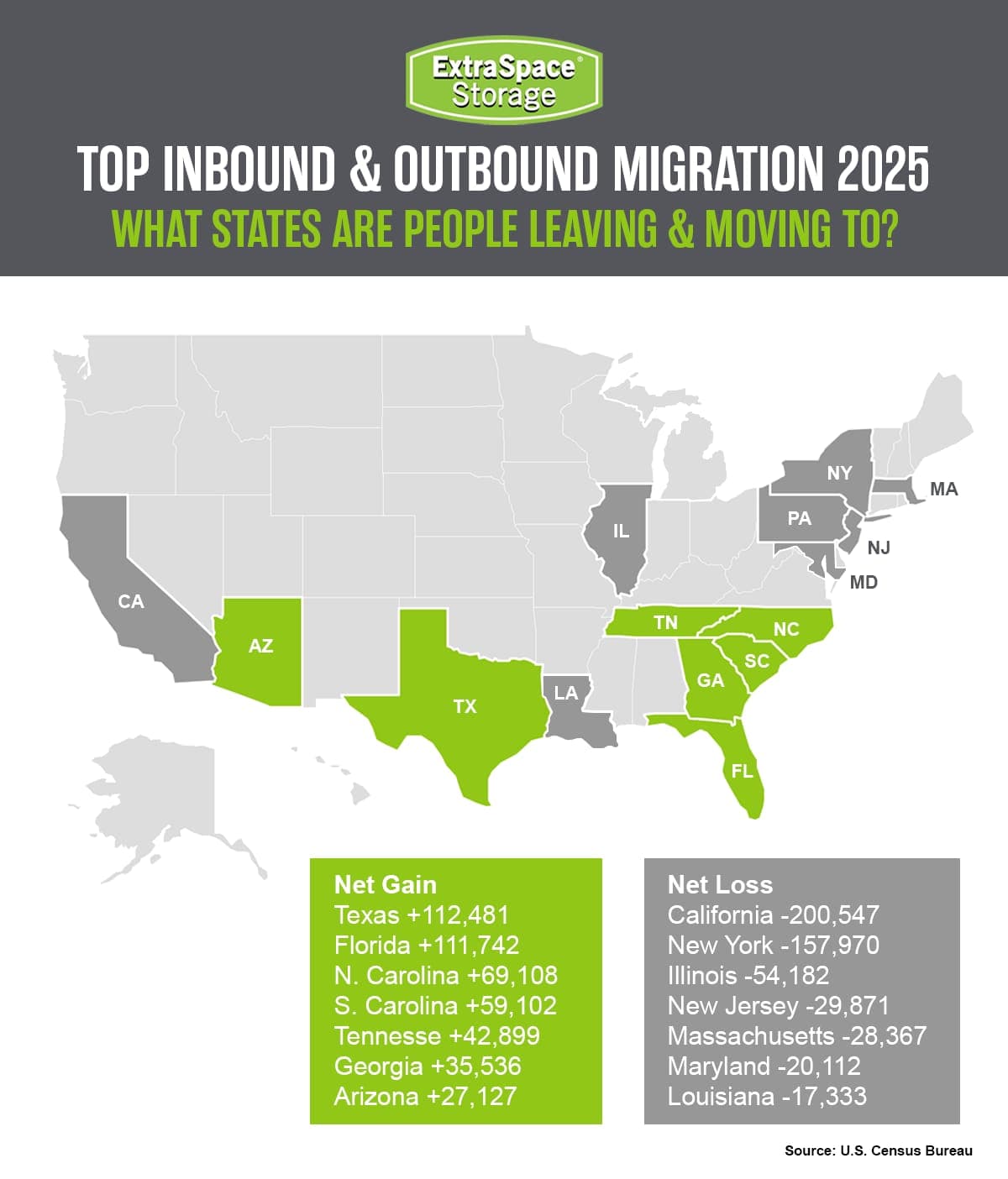
High-cost states like California, New York, and Illinois are losing residents to low-tax Sun Belt states, with Texas and Florida respectively gaining roughly 131,000 and 123,000 people in recent years. Census flow mapping also shows local moves tend to be to a more affordable neighboring area—like moving from Los Angeles to San Bernardino, or from Brooklyn to Queens. That said, it’s worth noting that some normally outbound states have pockets of inbound areas.

Find Affordable Self Storage Near You
Extra Space Storage has over 4,000 locations across the U.S. with friendly customer service, advanced security features, and affordable month-to-month rates.
- Save up to 40% off online
Economic & Demographic Impacts on Moving Trends
Economic conditions heavily influence when and how people move. In the current climate, several economic factors are shaping moving trends.
Housing & Economic Pressures
Driven by shifting interest rate dynamics and growing home options, here is how evolving economic conditions are sparking a market recovery:
Rate Lock-In Thaw: The severe freeze on moves caused by sudden hikes in home prices and surges in mortgage and interest rates has gradually eased as buyers and sellers adapt to the current market.
Market Stabilization: Following historic lows in national mobility rates, real estate activity has shown a steady, modest recovery as growing home inventory is creating more room for buyers to explore options.
Generational Mobility Drivers
While life milestones like buying a home or retiring have traditionally prompted relocations, distinct generational priorities are currently redefining national migration patterns.
Ages 18–29: The most mobile demographic group. Moves are primarily driven by entering higher education, launching early careers, military service, and establishing independent households.
Ages 30–42: Driven largely by major family and lifestyle milestones like purchasing a first home, seeking larger living spaces for growing families, finding better school districts, and taking advantage of remote work flexibility.
Ages 43–58: Low overall mobility rate. Moves are typically tied to career advances, corporate relocations, or downsizing as children leave the home.
Ages 59+: Mobility is heavily tied to retirement transition.
Income Mobility Drivers
Income doesn't just dictate budget—it shapes the entire moving journey. From local necessity-driven moves to long-distance lifestyle upgrades, here is how moving motivations break down by income tier:
Lower-Income Households: Mobility is primarily reactive or necessity-driven. Common catalysts include changing rent prices, housing cost burdens, job displacement, or family changes. Moves are predominantly local (intra-county or intra-city).
Middle-Income Households: Often motivated by real estate affordability and suburban expansion. Many choose long-distance or interstate moves specifically to lower their overall cost of living or stretch their home-buying budget.
Higher-Income Households: Higher rate of discretionary and long-distance relocations. Moves are often driven by quality-of-life preferences, tax optimization, major career transfers, or purchasing vacation/secondary properties.
Housing Type Mobility Factors
Whether you rent or own—and who shares your living space—fundamentally changes how, why, and how often you pack up and relocate.
Renters: Relocate significantly more often than homeowners due to lease flexibility, lower moving costs, and fluctuating rental rates.
Homeowners: Exhibit much lower mobility due to transaction costs, property equity, mortgage commitments, and neighborhood ties. Moves are usually tied to long-term equity cash-outs, desires to up or downsize, or major interstate career shifts.
Single Adults: Move more frequently and show a stronger preference for urban centers, walkable neighborhoods, and areas with high job density and abundant social opportunities.
Families with Children: Prioritize stability, safety, suburban single-family housing, larger lot sizes, and top-performing public school districts. Interstate moves are often carefully timed around school calendars.
Multi-Generational Households: A growing segment of Americans are moving into larger homes or properties with accessory dwelling units (ADUs) to accommodate aging parents or young adult children, driven by shared housing costs and caregiving needs.
How the Storage Industry Aligns with Moving Trends
Moving and storage go hand in hand, as people often need a place to store their belongings during a move—so it’s no surprise that self storage trends closely mirror moving trends. In fact, industry analyses indicate that 25% of self storage renters listed moving as their primary reason for needing it, making storage a flexible extension of the moving process. For example, many people put furniture and other items in short-term storage to help them navigate the time between homes. Or if you need to temporarily downsize to a smaller space, a storage unit can provide a place for overflow belongings you want to keep.
Another alignment between self storage and moving industries is seasonal demand. Both moving rates and storage unit occupancy peaks in late spring and summer. For instance, college students often move out and store dorm items for the summer, while families who sell a home in the spring rush might need to temporarily store items before a mid-summer move-in. Moving and storage companies are also increasingly integrated services, with many full-service moving companies offering storage solutions—either through short-term holding in a warehouse or partnerships with self storage facilities. Likewise, storage companies often offer moving trucks and referrals. Since customers commonly need both services at once, this pairing makes sense from a business standpoint.
Notable Self Storage Trends
Self storage preferences are pivoting toward smaller, cost-effective spaces as lifestyle needs evolve. Instead of storing an entire households' worth of items, today's renters are more focused on partial storage—whether they're storing vehicles, protecting items while renovating a new home, or seeking seasonal storage solutions.
The 10×10 unit is the most popular size, representing approximately 27% of all rentals.
National storage occupancy holds at 78.1%, with renters keeping their units longer. This slower turnover means fewer available units for new movers, which can drive up demand and prices.
Partially due to the influx of new residents to the region, the South leads the nation in self storage usage, where roughly 12% of the region’s households—totaling about 6.1 million homes—rent a unit.
Frequently Asked Questions
How often does the average American move?
The average American will move between 11 and 12 times in their lifetime. This works out to moving roughly every five to seven years.
What are common reasons people move?
Some of the most common reasons people move include:
A job change or remote work possibilities
School district considerations
Marital or relationship changes
Outgrowing a home or downsizing
Proximity to family
How far do most people move?
More than 53% of all relocations happen within the very same county, and 78% stay within state lines—leaving long-distance, interstate moves to account for just over 20% of all relocations.
What time of year do most people move?
The vast majority of people move during late spring and summer, specifically from May through September. This is often due to better weather and families planning moves around a school year.
Where are the most people moving right now in the U.S.?
Most people in the U.S. are currently moving to the Sun Belt region, with Florida, Texas, North Carolina, and South Carolina leading all states in net population gains.
***
Need help with your move? Extra Space Storage has moving tips, calculators, and expert advice to make your transition easier in our Moving Resources Hub. Plus, with storage locations across the U.S., we’ve got a storage space ready for you. Find cheap storage today!

Most Viewed Tools & Guides

Free Moving Cost Calculator
How much does it cost to move? Use this moving cost calculator from Extra Space Storage to get a moving cost estimate and compare moving options.

Moving Truck Size Calculator: What Size Truck Do You Need?
How big of a box truck do you need for your upcoming move? Check out this moving truck size calculator to find the right moving truck rental for you!

Cheapest Ways to Ship Boxes Across the Country
Need to ship moving boxes across the country? Explore the most affordable ways to ship boxes in this guide!

How to Protect Your Furniture When Moving
Whether you're moving across the country or relocating to a nearby area, our tips to protecting your furniture can help you doing your move!

What Size Apartment Do I Need & How Much Square Footage?
Finding the right apartment size can be difficult. From average apartment square footage to budget and layout, our apartment size guide can help you decide!
Author Profile
Quinn Johnson
Quinn Johnson is a moving expert and author for Extra Space Storage. He's moved over 15 times, including internationally, and helped countless others between their own homes. He's happy to lift some boxes for a friend as long as he's paid in pizza. As a writer and content creator for Extra Space Storage since 2019, Quinn shares helpful moving tips and info to alleviate the common stresses of moving.